
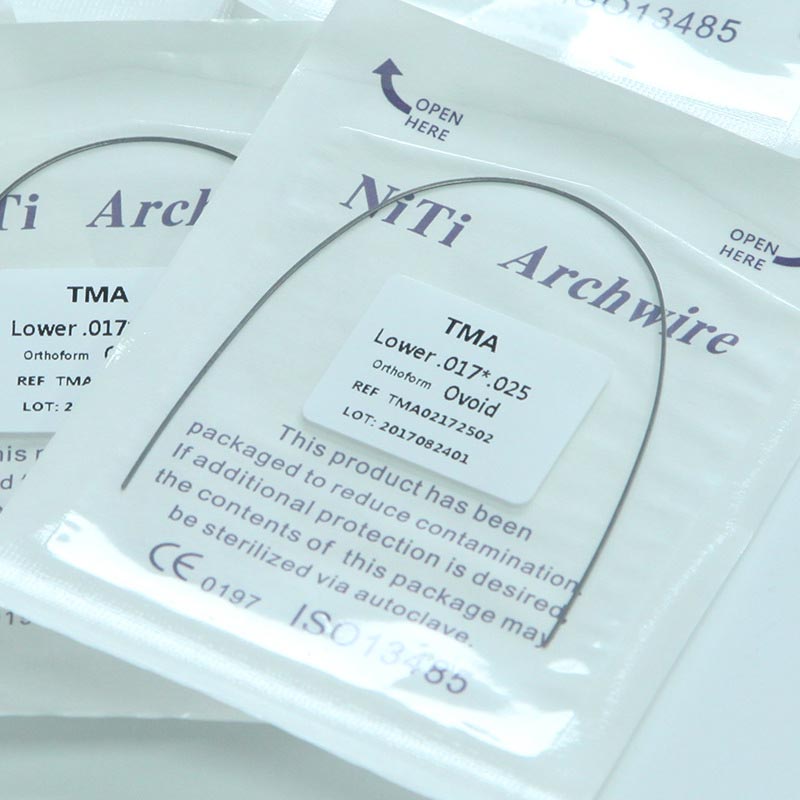
TMA archwires, or Titanium-Molybdenum Alloy (Beta-Titanium), are often considered the “workhorse” of orthodontics. They occupy a unique mechanical middle ground between the extreme flexibility of Nickel-Titanium (NiTi) and the rigid precision of Stainless Steel (SS).
Upper and Lower
Round: 0.012 / 0.014 / 0.016 / 0.018 / 0.020
Square: 0.014×0.025 / 0.016×0.022 / 0.016×0.025 / 0.017×0.022 / 0.017×0.025 / 0.018×0.025 / 0.019×0025
1. Composition and Physical Properties
TMA is a Beta-Titanium alloy. While traditional titanium exists in an alpha-crystalline structure at room temperature, the addition of molybdenum stabilizes the “beta” phase, which provides several distinct advantages:
- Composition: Typically 79% Titanium, 11% Molybdenum, 6% Zirconium, and 4% Tin.
- Modulus of Elasticity: Approximately 40% of Stainless Steel. This means it delivers about half the force of a steel wire of the same dimensions.
- Springback: It has roughly twice the working range of stainless steel, allowing it to move teeth further before needing a reactivation bend.
- Ductility: Unlike NiTi, which is brittle and breaks if bent sharply, TMA is highly formable. You can place permanent loops and bends directly into the wire.
2. Clinical Advantages
TMA is frequently selected for the intermediate and finishing stages of treatment for the following reasons:
- Gentle Force for Torque: Because it is less stiff than steel, a rectangular TMA wire can be used to introduce torque control (root movement) earlier in treatment without the excessive, painful forces of a similarly sized steel wire.
- Direct Welding: TMA is one of the few orthodontic alloys that can be welded without soldering. This allows clinicians to attach auxiliary hooks or springs directly to the archwire without destroying its mechanical properties.
- Biocompatibility: It is 100% Nickel-free, making it the primary choice for patients with nickel allergies who cannot tolerate NiTi or standard Stainless Steel.
- Formability: It is ideal for “detailing” (final small adjustments) because it holds its shape once bent, but is resilient enough to apply continuous force.
3. Limitations and Trade-offs
While highly versatile, TMA has a few mechanical drawbacks:
- High Surface Friction: TMA has the highest coefficient of friction among the three major archwire types. This makes it a poor choice for sliding mechanics (like closing extraction spaces by sliding brackets along the wire).
- Breakage Risk: While formable, it is more prone to fracture than stainless steel if a bend is overworked or “sharpened” too aggressively.
- Cost: It is significantly more expensive to manufacture than stainless steel.
4. Comparison Table
| Property | NiTi (Nickel-Titanium) | TMA (Beta-Titanium) | Stainless Steel |
| Stiffness | Very Low | Intermediate | High |
| Formability | Poor (cannot bend) | Excellent | Excellent |
| Springback | Excellent | Good | Average |
| Friction | Low | High | Very Low |
| Nickel Content | High (~50%) | 0% (Nickel-Free) | Moderate (~8%) |
| Main Use | Initial Alignment | Torque & Detailing | Space Closure & Finishing |